

Show clients how common each defect is
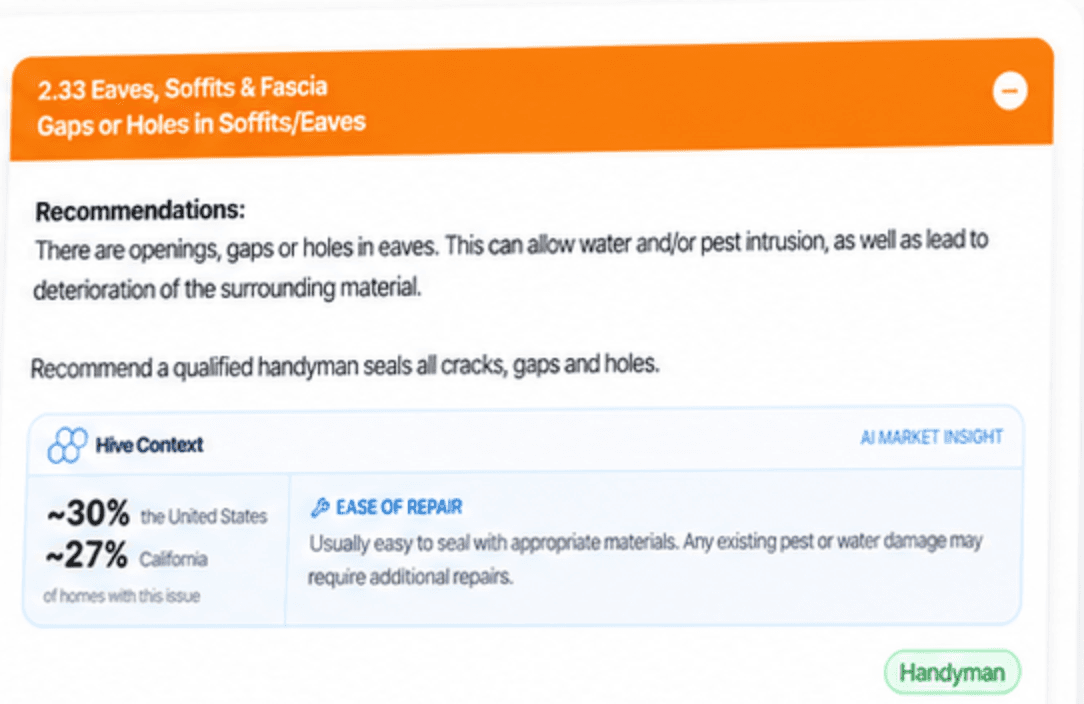
Context Layer adds a labelled box to each defect: how common the issue is nationally and in the state, and how involved the repair usually is. You type nothing extra.
- Every defect
- gets its own Hive Context box
- Every plan
- including the 10-report pack
- On or off
- by template, or for a single report
Put each finding in proportion
Clients see what is routine
A missing smoke detector can frighten a first-time buyer. With the context beside it, your report does not read as alarmist.
Expectations set before the contractor
The ease of repair line gives clients a sense of the work involved before they start calling around for quotes.
Kept apart from your findings
The box is labelled Hive Context and marked AI Market Insight, so clients can see it comes from Hive, not from your inspection.
How the Context Layer works
Choose the templates once. After that it runs on its own. Setup steps in the Hive docs
Step 1
Choose your templates
Pick the templates that use it by default. Turn it on or off for any single report.
Step 2
Inspect the way you do now
Nothing changes on site. You do not write the context or tag anything for it.
Step 3
It is added when you publish
Hive generates it when you publish the report, or when you generate a PDF beforehand.
What Yari Rincon tells her buyers
“… what I like most is that it briefly explains how easy or complicated it might be to fix this issue.”
Context Layer questions
What is the Context Layer?
Where do the numbers come from?
Does it create any liability for me?
Can I remove it from a report?
How the AI fits together is on the AI home inspection software page. Anything else: email support@hiveinspect.com.
Give every finding the context clients ask you for
Start with 5 free reports, no credit card. We move your templates, agreements, services, contacts and settings, and set up your account so it’s ready to run your business, free.